Updated: August 2026
Auditing a shipyard is not about judging craftsmanship from a distance; it is about verifying that a yard can repeat a result. Anyone can produce one good hull. What an owner needs is evidence of a system: consistent work in progress, records that match reality, and a management layer that knows exactly what is happening on each vessel in the yard.
- Inspect work in progress rather than finished vessels — process is visible only mid-build.
- Ask for records that should exist anyway: drawings in use, material receipts, inspection notes, snag lists.
- The strongest signal is a yard that volunteers a problem and shows you how it was closed.
Inspect the vessel nobody is showing you
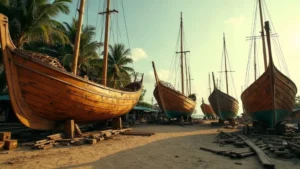
Every yard has a vessel it wants to show you and several it does not mention. The informative visit is the one where you walk the whole site. Look at the hull that is halfway planked, the one waiting for an engine, and the one that has clearly been sitting for months. Ask what each is, who owns it, and why it is at that stage. The answers, and the willingness to give them, form the core of the audit.
Stalled vessels are not automatically a bad sign; owners run out of funds, projects change hands, disputes happen. What matters is whether the yard can explain them coherently. A site with several stalled hulls and vague explanations is telling you that either its contracts or its cash flow are not working.
What to look at with your own eyes
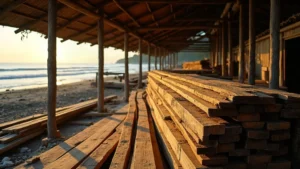
Concentrate on the things that reveal habit rather than talent. Is timber stored off the ground, under cover, stacked with air gaps, and clearly segregated by species and purpose? Are fastenings and fittings stored in a way that prevents corrosion and mix-ups? Is there a defined area for machining and another for assembly, or does the work happen wherever there is space? Are power tools and cables in reasonable condition, and is there any evidence of fire precaution beyond a single extinguisher near the office?
Then look at the work itself. Fairness of frames, consistency of seam widths, quality of scarf joints, straightness of deck beams, tidiness of fastening patterns. You do not need to be a shipwright to see whether the same standard is being applied along the whole length of a hull. Variability is more diagnostic than absolute quality: it usually means the crew changes, or supervision is thin.
The records that should already exist
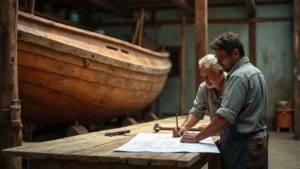
Ask to see the drawing set currently being worked from, and check that it is the latest revision and that it is physically present where the work is happening. Ask for material receipts for the timber in the current build. Ask whether inspection notes are written down and, if so, to see the last few. Ask how a snag list from a recent delivery was recorded and closed. None of these are unreasonable requests; all of them exist naturally in a yard that manages its work.
The absence of records is not proof of poor building — many excellent traditional yards run on memory and craft. But it does tell you where your own effort must go. If the yard keeps no written trail, you need an owner-side representative who will create one, because otherwise disputes later will be settled by recollection.
Talking to the people who actually build
Time spent with the yard manager tells you about commercial intent. Time spent with the lead shipwright tells you about capability. Ask how many people work on a hull of your size, how long the current build has taken, what the hardest part of the last project was, and what they would do differently. Craftspeople generally answer such questions honestly and in detail, and the answers reveal whether the yard is resourced for your vessel.
It is also worth learning who is permanent and who is engaged per project. A yard whose core team has been together for years carries knowledge that does not exist on paper. A yard that assembles a crew for each contract may still build well, but the risk profile is different and the supervision requirement is higher.
Warning signs that should stop a contract
Some findings are worth walking away from. A yard that will not let you see a build in progress. A yard that cannot name a single completed vessel you may inspect or whose owner you may contact. A yard that resists writing a specification schedule. A yard that wants a large front-loaded payment before any physical milestone. A yard that reacts defensively to routine questions about certification or insurance. And a yard where the explanation changes between the first visit and the second.
Conversely, the strongest positive signal is a yard that raises a past problem before you find it, explains what went wrong, and shows you the correction. That behaviour predicts how they will handle the problem that inevitably arises during your own build, which is the thing you are really buying.
Frequently asked questions
How long should a proper yard audit take?
A meaningful first visit takes most of a working day, not an hour. You need time to walk every vessel on site, talk to the people doing the work, look at storage and workshops, and review records. A second visit a few weeks later, unannounced if possible, is worth more than extending the first.
Should I bring an independent surveyor to the audit?
For any significant build, yes. A surveyor who works regularly with the vessel type will read scantlings, fastening patterns and joint quality faster and more reliably than an owner can, and will ask the technical questions that shape the contract. The cost is small relative to what it prevents.
What if the yard has no written records at all?
Treat it as a supervision requirement rather than an automatic disqualification. Many capable traditional yards operate on craft knowledge. If you proceed, budget for an owner-side representative who visits regularly and creates the written trail, and make photographic progress reporting a contractual obligation.
Can I audit a yard remotely?
Partially. Video walkthroughs, dated photographs and reference calls with previous owners are genuinely useful and can filter a shortlist. But storage discipline, workshop condition, fire practice and the atmosphere among the crew do not transmit well through a screen, and those are exactly the habits that predict how your vessel will be built.
Related reading
Speak to the build desk
If you have shortlisted a yard, an independent pre-contract audit is the least expensive risk reduction available. Send the vessel length, intended operating area and target delivery window to our build desk on WhatsApp at +62 811-3941-4563 or by email at [email protected], and you will receive a written response covering yard options, realistic programme dates and the documents required before any money moves. All figures are quoted in USD.
Who you contract with
Phinisi Shipyard is a specialist maritime brand and digital platform under Juara Holding Group. Construction, new-build project management, supervision, handover and vessel-sale contracts are issued by PT Komodo Galangan Nusantara. Technical and commercial vessel management is contracted separately through PT Komodo Vessel Management, and brokerage, central agency and charter marketing through PT Komodo Bahari Nusantara. Separate contracts, separate fees, separate ledgers, one integrated maritime ecosystem.