Updated: August 2026
Digital tools are entering traditional yards unevenly and pragmatically. Design software and simple digital record-keeping have spread furthest because they solve real problems at very low cost. Machine cutting and scanning appear where volume justifies them. The hull shaping itself remains stubbornly, and appropriately, manual.
- CAD and hydrostatics now underpin most serious builds, even where the hull is shaped by hand.
- Digital records — photographs, messaging, shared drawings — have changed owner communication more than production.
- Machine cutting suits repeatable components; it does not replace the master builder’s eye.
Design software and the drawing that everyone shares
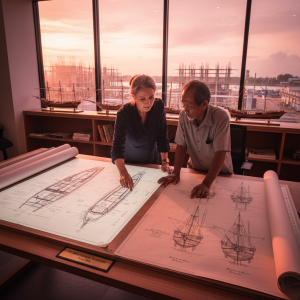
The most consequential digital change is not on the slipway; it is in the drawing. Computer-aided design and hydrostatic analysis let a designer check stability, displacement and trim before any timber is cut, and let an owner see a general arrangement they can actually understand. That reduces the most expensive category of build error: discovering after construction that the vessel does not float as intended or that the interior does not work.
It also creates a shared reference. A drawing set that exists digitally can be revised, distributed and version controlled, which matters enormously when a yard, a designer, a surveyor and an owner in three time zones need to be working from the same document. The persistent failure is revision control: the crew building from a printed sheet that is two revisions old.
Machine cutting where it earns its place
CNC routing and machine cutting appear in Indonesian yards for components that repeat: bulkhead panels, joinery parts, jigs and templates. Where a shape recurs, machine accuracy saves time and reduces variation. Where a shape is unique and must be fitted to an existing hull — which describes most of a traditional build — the setup cost exceeds the benefit and hand fitting wins.
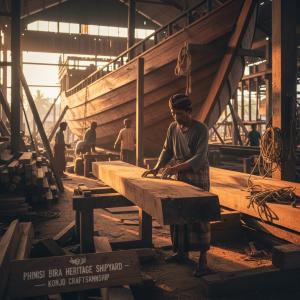
This is why the technology has not displaced the craft. Shell-first construction fits each plank to the hull as it exists, not to a theoretical model, and no amount of machine precision helps if the hull differs slightly from the drawing, which it always does.
Scanning, and its useful applications
Three-dimensional scanning has real uses in a traditional yard, mostly in refit and interior work rather than in new hull construction. Scanning an existing hull to design a replacement component, to plan an interior fit, or to record as-built geometry saves substantial measuring time and produces a record that survives the people who made it.
For a new build, its most valuable application is documentation: an as-built record of the hull as it actually exists, which is far more useful for later refit work than the original drawings of what was intended.
The quiet revolution in communication
The change that has affected owners most is mundane: inexpensive cameras, messaging apps and shared cloud folders. An owner in another country can now see their hull weekly, ask a question and receive an answer within hours, and keep an archive that would once have required a dedicated representative. That has reduced the information asymmetry that historically made remote builds risky.
It has not eliminated it. Photographs show what the camera was pointed at, and messaging produces a fragmented record with no structure. The yards and owners who benefit most are those who impose a format — fixed views, regular intervals, a written monthly summary — rather than relying on an unstructured stream of images.
What will stay manual
The hull’s fairness, the fit of a plank, the reading of a piece of timber, the decision to remake a component rather than persuade it into place: these are judgement, and they belong to experienced hands. Technology can verify them after the fact, and measurement can confirm them, but it cannot make them.
That is not nostalgia. It is a description of where value sits in this construction method, and it explains why the correct question about a yard is still about its master builder and its crews rather than about its equipment list.
Where digital tools fail in practice
Two failure modes recur. The first is revision drift: drawings updated digitally while the crew continues to build from an older printed sheet nobody replaced. The fix is procedural — one controlled source, dated issues, and a check that the print at the work face matches the current revision. The second is false confidence, where a beautifully rendered model persuades everyone that a layout works, when the same layout fails the moment a real person tries to carry a tray through it.
The remedy for both is physical verification. Mock up critical spaces in timber and cardboard before committing joinery; walk the corridors at full scale; sit on the berth and check the headroom. Yards do this routinely for their own reasons, and owners who ask for it on the cabins that matter most rarely regret the day it costs.
Frequently asked questions
Should I insist on a CAD-designed hull?
For any significant vessel, yes. Computer-aided design and hydrostatic analysis let stability, displacement and trim be checked before construction, and give the surveyor and the owner a common reference. The hull can still be built by traditional methods from those drawings.
Does a yard need CNC equipment to build well?
No. Machine cutting helps with repeatable components but is irrelevant to the shaping that defines a traditional hull. Judge a yard on craft, supervision and delivery record rather than on its equipment list.
How do I keep drawing revisions under control?
Number and date every revision, distribute only from one source, and require that the copy at the work face is checked against the current issue at defined intervals. Most drawing disputes come from an old print still being used on the hull.
Related reading
Working with our build desk
If your build involves designers, a yard and a surveyor in different places, revision control is worth formalising early. You can reach the build desk on WhatsApp at +62 811-3941-4563 or by email at [email protected]. Construction and supervision contracts are issued by PT Komodo Galangan Nusantara; Phinisi Shipyard is a specialist maritime brand under Juara Holding Group.