Updated: August 2026
Indonesia does not have one phinisi shipyard industry; it has several overlapping ones. Traditional timber building, semi-industrial timber building with modern systems, and composite or steel construction each sit in different places, work at different speeds and answer to different standards. Choosing a yard means first deciding which of those industries you are actually buying from.
- Traditional timber phinisi work remains concentrated in South Sulawesi, where the craft lineage is strongest.
- Systems integration, joinery and certification support are frequently completed elsewhere, closer to ports and suppliers.
- A yard’s current order book matters as much as its skill: capacity, not capability, is what usually delays a build.
Three industries wearing one name
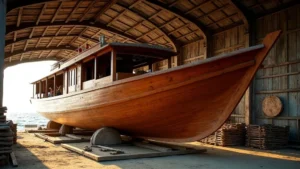
When an owner says they want to build at a phinisi shipyard, they can mean three quite different things. The first is the heritage yard: an open beach or riverside site where master shipwrights build shell-first in timber, largely without covered sheds, using knowledge passed down through families. The second is the hybrid yard, where the hull is built traditionally but the vessel is then fitted with modern propulsion, air-conditioning, water makers and navigation equipment, often by specialists brought in for that phase. The third is the industrial yard building in steel, aluminium or composite, which may produce a phinisi-styled vessel without traditional timber construction at all.
Each route produces a legitimate vessel. They simply differ in what they are good at. The heritage route buys you craft, character and a hull form refined over generations. The hybrid route buys you that hull plus reliable systems. The industrial route buys you predictability, documentation and easier classification, at the cost of the timber tradition that makes a phinisi a phinisi. Confusion between these three is the single most common source of disappointment in Indonesian yacht building.
Reading capability rather than reputation
Reputation travels faster than evidence in this industry. A more useful approach is to assess a yard against four practical questions. Has it delivered a vessel of comparable length and system complexity in the last few years? Can it show the build in service today, with an owner or operator willing to talk? Does it have covered space or a plan for weather protection during the joinery and finishing phases? And does it employ, or reliably subcontract, the electrical and mechanical trades that a modern vessel needs?
Those four answers tell you more than any brochure. A yard that has built beautiful sixteen-metre hulls for twenty years may be an excellent choice for a similar vessel and a poor choice for a thirty-five-metre commercial build with a complex systems package. The skill is real either way; the question is whether it matches your brief.
Capacity is the constraint nobody plans for
Owners tend to plan for cost and quality, then discover that the binding constraint is capacity. A good yard has a finite number of building positions, a finite crew of skilled shipwrights and a queue. If the yard is already committed for the next eighteen months, your build either waits or is squeezed into a slot the yard cannot properly resource. The second outcome is worse than the first, because it produces a build that is technically started and practically stalled.
The honest question to ask early is simple: which building position will my vessel occupy, when does it become free, and who else is in the queue ahead of me? A yard that answers plainly is telling you it manages its own workload. A yard that cannot answer is telling you something too.
Distance from suppliers is a real cost line
The romance of a remote beach yard has a logistics bill attached. Engines, generators, air-conditioning plant, navigation electronics, glazing, sanitary systems and specialised fastenings largely arrive from elsewhere. Every kilometre between the yard and the nearest capable port adds freight, adds handling risk and adds delay when something arrives damaged. This does not make remote yards a poor choice; it makes the logistics plan a part of the build plan rather than an afterthought.
The same applies to the finishing phase. Fine joinery, upholstery and electronics commissioning often go faster where skilled subcontractors are available locally. Many owners therefore split the programme deliberately: hull and structure where the craft is strongest, fit-out and commissioning where the trades and the suppliers are.
What a national view is actually good for
Looking at Indonesia as a single yard map is useful for one decision above all: sequencing. It tells you where to build the hull, where to fit out, where to survey and where to base the vessel for its first season. Owners who treat the country as a network of specialised capabilities usually finish faster and argue less than owners who insist that one site must do everything.
It also protects against a quieter risk. A single yard that promises hull, systems, joinery, certification and delivery may be genuinely capable, or it may simply be unwilling to admit which parts it subcontracts. Knowing the map lets you ask who is actually doing each phase, which is the question that separates a managed build from a hopeful one.
Owners who would rather approach the yard map through a single managed relationship can start at the Komodo Luxury boat construction desk, which coordinates construction briefs across the group before a yard is selected.
Frequently asked questions
Are all phinisi built in South Sulawesi?
The traditional timber craft is strongly concentrated there, and the shipwright lineage that makes the type distinctive is a South Sulawesi inheritance. But many vessels are completed, fitted out, surveyed and based elsewhere, and phinisi-styled vessels are also produced in other materials at industrial yards in other parts of the country.
How do I verify a yard before signing?
Visit while a comparable vessel is under construction, ask to see a build in service with a contactable owner or operator, review the yard’s handling of a previous snag list, and confirm which trades are in-house versus subcontracted. Evidence you can inspect beats testimonials you cannot.
Can the hull be built at one yard and fitted out at another?
Yes, and it is a common approach for larger or more complex vessels. It requires a clear transfer point in the contract, an agreed condition survey at handover between yards, and a project manager who owns the interface. Split programmes fail at the seam, not in the middle.
Does a bigger yard mean a better build?
Not automatically. Size helps with systems, documentation and schedule discipline. Small yards often produce exceptional craftsmanship. The right measure is fit between the yard’s proven output and the vessel you intend to own.
Related reading
Speak to the build desk
If you are still narrowing the yard shortlist, an honest capability and capacity review saves months later. Send the vessel length, intended operating area and target delivery window to our build desk on WhatsApp at +62 811-3941-4563 or by email at [email protected], and you will receive a written response covering yard options, realistic programme dates and the documents required before any money moves. All figures are quoted in USD.
Who you contract with
Phinisi Shipyard is a specialist maritime brand and digital platform under Juara Holding Group. Construction, new-build project management, supervision, handover and vessel-sale contracts are issued by PT Komodo Galangan Nusantara. Technical and commercial vessel management is contracted separately through PT Komodo Vessel Management, and brokerage, central agency and charter marketing through PT Komodo Bahari Nusantara. Separate contracts, separate fees, separate ledgers, one integrated maritime ecosystem.