Updated: August 2026
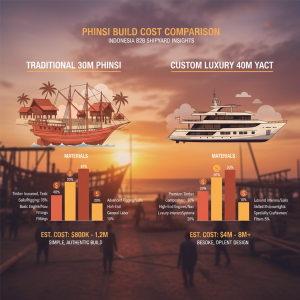
- Entry-Level Charter (25-30m): Typically costs between $400,000 and $800,000.
- Mid-Range Luxury (35-45m): The most common category, ranging from $1 million to $2.5 million.
- Bespoke Superyacht (50m+): Can easily exceed $4 million, with costs driven by imported materials and high-end systems.
The air on the southern coast of Sulawesi hangs thick with the scent of sawdust and clove cigarettes. Along the white-sand beach of Bira, the rhythmic thud of hand-forged adzes shaping ironwood planks is a sound that has echoed here for centuries. This is the cradle of the phinisi, the majestic two-masted schooners that have become the ultimate platform for exploring Indonesia’s 17,000 islands. As an editor for Departures, I’ve sailed on a half-dozen of these vessels, from rugged expedition craft to floating palaces. But the question I receive most often isn’t about the destinations; it’s about the ships themselves. What does it actually cost to commission one of these maritime masterpieces from the ground up?
Demystifying the Base Price: Hull, Timber, and Tradition
The journey of any phinisi begins not with a blueprint, but with a keel-laying ceremony and the selection of timber. This is the heart of the vessel, and it forms the foundational cost. The builders, master craftsmen from the Konjo tribe, work from memory and instinct, a tradition so unique it was inscribed on the UNESCO list of Intangible Cultural Heritage. The primary materials are two formidable tropical hardwoods: ironwood (kayu ulin) for the keel and hull frames, and teak (kayu jati) for the decking and superstructure. The price of this timber is the first major variable. High-quality ironwood, prized for its incredible density and resistance to marine borers, can command over $2,000 per cubic meter. A 40-meter phinisi might require 150 cubic meters of ironwood and another 100 cubic meters of teak, putting the raw material cost for the hull alone well into the $400,000 range. I spoke with a project manager in Bulukumba who noted that securing a reliable supply of legally sourced, properly seasoned timber is now one of the biggest challenges, often adding 10-15% to the initial budget. For a prospective owner, the “sail-away” bare hull and superstructure, handcrafted by these artisans over 10-14 months, represents the first major investment milestone, typically falling between $350,000 and $750,000 depending entirely on the vessel’s length and beam.
The Engine Room: Power, Propulsion, and Technical Systems
While the soul of a phinisi is its traditional wooden hull, its heart is a modern, reliable engine room. The romantic vision of sailing silently through the Komodo archipelago is wonderful, but the reality of charter schedules and traversing vast distances between anchorages like Raja Ampat and the Banda Islands demands serious mechanical power. This is where the Indonesian phinisi yacht price begins to climb significantly. A pair of new, marine-grade diesel engines from reputable brands like Yanmar or Mitsubishi, each producing around 500 horsepower for a 45-meter vessel, can cost between $90,000 and $160,000. But the main engines are just the start. A modern luxury phinisi requires robust electrical systems, which means installing at least two, sometimes three, generators. These units, which run everything from air conditioning to water makers, can add another $40,000 to $70,000. Then there’s the essential life-support equipment: a high-capacity desalination system, capable of producing 10,000 liters of fresh water per day, will set you back $20,000 to $50,000. The full suite of navigation and communication equipment—radar, GPS, satellite communications, sonar—can easily exceed $75,000. When you factor in the plumbing, wiring, steering systems, and critical safety equipment to meet international maritime standards, the total cost for the complete mechanical, electrical, and plumbing (MEP) package for a luxury phinisi often lands between $300,000 and $600,000.
Interior Fit-Out: From Spartan to Six-Star Suites
Once the hull is watertight and the engine room is installed, you are left with a vast, empty wooden shell. The interior fit-out is where the budget can truly spiral, and where the line between a simple charter boat and a world-class superyacht is drawn. This phase is all about customization and material choice. A standard charter phinisi might feature six to seven functional, air-conditioned cabins with simple teak veneers, locally sourced fabrics, and basic en-suite bathrooms. The total interior cost for such a vessel might be in the region of $250,000. On the other end of the spectrum, a private owner might commission an interior from a renowned European design firm. I recently toured a 55-meter phinisi where the owner’s suite alone, featuring Italian marble in the bathroom, a walk-in wardrobe with dehumidifiers, and a custom sound system, cost over $200,000. The galley on this vessel was a professional-grade stainless steel affair that would be at home in a Michelin-starred restaurant, a $100,000 investment. High-end finishes like hand-stitched leather wall panels, designer lighting, and bespoke furniture can push the cost of a luxury interior past $1.5 million. This level of personalization is where working with an experienced phinisi shipyard becomes indispensable. They can translate a vision into reality while navigating the complex logistics of importing materials and managing specialized artisans, from cabinet makers to stone masons.
The Final 20%: Rigging, Decking, and Finishing Touches
As any seasoned boat builder will tell you, the last 10% of the project often consumes 30% of the budget. For a phinisi, this final phase involves a host of expensive and labor-intensive details. The iconic rigging, with its two towering masts and seven traditional sails, is a key element. While most modern phinisis run on engine power 90% of the time, the rig must be fully functional and safe. Crafting the massive wooden masts, sourcing high-quality sails, and installing all the necessary stainless steel rigging can cost anywhere from $50,000 to $120,000. The teak decking is another substantial line item. A beautiful, expansive teak deck is a hallmark of a luxury yacht. For a 40-meter phinisi, the cost of the grade-A teak and the highly skilled labor to install and caulk it can easily reach $150,000. Then come the myriad finishing touches: custom-fabricated stainless steel railings and hardware, multiple coats of marine-grade varnish and paint, underwater lighting, and the all-important tender boats and water toys. A high-quality primary tender (a rigid inflatable boat or RIB) can cost $40,000, and outfitting the yacht with a dive compressor, kayaks, paddleboards, and other guest amenities can add another $50,000. These final elements are what transform a well-built boat into a truly finished luxury vessel, and they are critical components of the overall Indonesian phinisi yacht price.
Beyond the Build: Operational Costs and Charter Potential
The purchase price is only the beginning of the financial story. A prudent owner must budget for annual operational costs, which are typically estimated at 8-10% of the initial build cost. For a $2 million phinisi, this means an annual budget of $160,000 to $200,000. The single largest operational expense is the crew. A 40-meter charter phinisi operating in destinations like Komodo National Park or Raja Ampat requires a crew of 12 to 16, including a Western cruise director, a captain, engineers, a chef, and deck/stewards. The total annual payroll can easily exceed $150,000. Other major costs include insurance (around 1-1.5% of the hull value, so $20,000-$30,000 per year), fuel, and maintenance. Every two to three years, the vessel must be dry-docked for hull inspection, antifouling paint, and system overhauls, a process that can cost $30,000 to $80,000. To offset these costs, most owners place their vessels on the charter market. According to Indonesia’s official tourism site, the demand for luxury liveaboards is booming. A high-end, 6-cabin phinisi can command charter rates from $50,000 to over $100,000 per week. With a successful charter season of 20-25 weeks, a phinisi can not only cover its operational costs but also provide a return on the initial investment. This business aspect underscores the importance of a build that is not just beautiful but also durable and efficient, a specialty of a top-tier phinisi shipyard.
Quick FAQ on Phinisi Build Prices
How long does it take to build a custom phinisi?
The entire process, from initial design to final delivery, typically takes between 18 and 36 months. The traditional hull construction by the Konjo builders in Bira or Tana Beru can be completed in about 12 months. The subsequent technical installation and luxury interior fit-out, which often happens in a more modern facility in Bali or Java, consumes the majority of the timeline.
What is the biggest “hidden cost” in a phinisi build?
Project management and import duties are the two most frequently underestimated costs. A professional, independent project manager will add 10-15% to the total budget but can save you much more by ensuring quality control and preventing costly mistakes. Secondly, import taxes in Indonesia on key components like marine engines, generators, electronics, and luxury interior fittings can be as high as 40%, a figure that must be factored into the budget from day one.
Can a foreigner legally own a phinisi in Indonesia?
Yes, it is possible and common. The standard legal structure is for the vessel to be owned by a foreign-owned Indonesian company, known as a PT PMA (Penanaman Modal Asing). Setting up this corporate structure correctly is a critical step that requires experienced legal counsel and typically costs between $5,000 and $10,000.
Is it less expensive to buy a second-hand phinisi?
While the initial purchase price of a used phinisi might be 40-60% of a new build, it is rarely the less expensive option in the long run. A 10-year-old wooden vessel will almost certainly require a major refit, including engine overhauls, system replacements, and extensive woodwork. A comprehensive refit can easily cost between $300,000 and $1 million, often erasing any initial savings and resulting in a vessel that still lacks the modern efficiencies of a new build.
Building a custom Indonesian phinisi yacht is an undertaking that is as much a passion project as it is a financial investment. It is a unique opportunity to create a vessel that is a direct reflection of your vision, built upon centuries of maritime heritage. The path from a raw ironwood keel on a sandy beach to a fully-realized luxury yacht navigating the turquoise waters of the Coral Triangle is complex and filled with variables. Navigating this intricate process, from the first sketch to your maiden voyage, requires a partner with deep-seated expertise and an unwavering commitment to quality. To see what is truly possible when tradition meets uncompromising modern luxury, I suggest you begin by exploring the portfolio of bespoke vessels crafted by the master builders at the Phinisi Shipyard.