Updated: August 2026
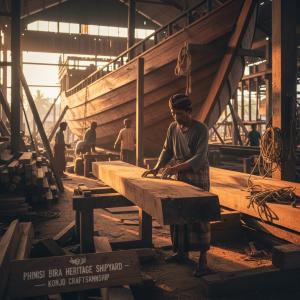
Indonesian boatbuilding is not one culture. Broadly, Sulawesi carries the traditional timber craft lineage with shell-first construction and master-builder judgement, while Java concentrates industrial capability, supplier networks and documentation-driven process. Owners get the best outcomes when they use each for what it is genuinely good at.
- Sulawesi: craft depth, timber tradition, hull form judgement, lower documentation intensity.
- Java: supplier access, systems integration, workshops, easier logistics and certification support.
- Many strong builds are hybrids — hull in one culture, fit-out and commissioning in the other.
Two different kinds of knowledge
The knowledge that builds a phinisi hull in Sulawesi is embodied rather than documented. It lives in the hands and eye of a master builder who knows what a plank will do before it is bent, and it is transmitted by working alongside someone who already has it. The knowledge that runs an industrial yard is procedural: drawings, schedules, inspection records, and a system that produces a repeatable result with interchangeable staff.
Neither form is superior in the abstract. Embodied knowledge produces hulls of a quality that documentation cannot specify into existence. Procedural knowledge produces predictability, traceability and easier compliance. The friction appears when an owner expects one culture to deliver the other’s strengths — asking a traditional yard for full documentation packages, or asking an industrial yard for a hand-shaped hull with genuine character.
Supply chains and the tyranny of distance
The strongest practical argument for Java-based work is proximity to suppliers. Engines, generators, electronics, sanitary systems, glazing, upholstery and specialist fabrication are more readily available where industry is concentrated, and freight and lead times shrink accordingly. When something arrives damaged or wrong, the replacement cycle is measured in days rather than weeks.
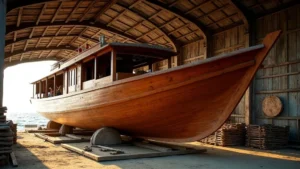
Against that, timber supply and traditional trades are naturally closer to the Sulawesi yards, and the cost of moving finished hulls is not trivial. The right split depends on the vessel: a systems-heavy commercial liveaboard tilts toward finishing near suppliers, while a simpler traditional vessel may sensibly be completed where it was built.
Documentation and certification culture
Yards accustomed to commercial and regulated work generally handle survey attendance, inspection records and certification paperwork as routine. Yards rooted in traditional practice may do the physical work to a high standard while keeping little written record of it. Neither is dishonest; they are different operating cultures.
If a build must be certified for commercial passenger use, that difference becomes a live risk. Either choose a yard with a documentation culture, or accept that you must supply it — an owner-side representative who creates the record, arranges survey attendance and keeps the paperwork moving in parallel with the timber.
The hybrid build in practice
The hybrid approach — hull built traditionally, then moved for systems, joinery and commissioning — is common for larger vessels and works well when three things are handled properly. There must be a defined transfer point with a condition survey at handover between yards. There must be one party responsible for the interface, so that the second yard does not inherit ambiguity. And the delivery voyage between sites must be planned, insured and crewed as the passage it actually is.
Where hybrids fail, it is almost always at the seam. The first yard says the hull was fair on departure; the second says it was not. Without a documented condition survey at the transfer, that dispute has no resolution except negotiation, and the owner funds it.
Choosing without romanticising
It is easy to romanticise the beach yard and dismiss the industrial one, or to do the reverse and treat traditional building as unreliable. Both instincts cost money. The honest way to choose is to write down what your vessel actually needs — hull character, systems complexity, certification requirement, schedule certainty — and then to weigh yards against that list rather than against an image.
Most owners find the answer is not one place. It is a sequence, planned deliberately, with someone accountable for the handovers between stages.
Cost is not where you think it is
Owners frequently assume that building in a traditional yard is straightforwardly less expensive. On the hull, that is often true: labour rates and overheads are lower, and the construction method uses less industrial plant. But the hull is rarely more than a portion of a modern vessel’s cost. Once engines, generators, air-conditioning, water production, electronics, glazing and interior fit-out are included, the balance shifts toward items that cost the same wherever they are installed and cost more where they are hard to deliver.
The genuinely regional cost variables are therefore freight, subcontractor travel and time lost waiting for parts. A remote yard with a lower hull price can end up more expensive overall on a systems-heavy vessel, while being clearly less expensive on a simple traditional one. This is why the correct comparison is always total delivered cost against a normalised specification, never a per-metre hull rate quoted in isolation.
Frequently asked questions
Is a hull built in Sulawesi better than one built elsewhere?
For traditional timber phinisi construction, the craft depth in South Sulawesi is genuine and difficult to replicate. That does not make every Sulawesi-built hull better than every hull built elsewhere; individual yard quality varies widely within any region.
How much does moving a hull between yards cost?
It depends on distance, vessel size and whether the hull moves under its own power or is towed, and it should be priced explicitly rather than assumed. The larger consideration is insurance and the condition survey at each end, without which a hybrid build has an unowned risk gap.
Can one yard genuinely do everything?
Some can, particularly for smaller and simpler vessels. For a systems-heavy commercial build, verify which trades are in-house and which are subcontracted, and to whom. A yard that subcontracts openly is easier to manage than one that implies capability it buys in.
Related reading
Working with our build desk
If you are weighing a single-site build against a hybrid programme, the transfer point is where the decision should focus. You can reach the build desk on WhatsApp at +62 811-3941-4563 or by email at [email protected]. Construction and supervision contracts are issued by PT Komodo Galangan Nusantara; Phinisi Shipyard is a specialist maritime brand under Juara Holding Group.