Updated: August 2026
Phinisi Shipyard is a curated Indonesia luxury tourism experience offered by Phinisi Shipyard: handpicked routes, vetted operators, transparent pricing, and 24/7 concierge support across Indonesia.
- What makes Phinisi Shipyard a premium experience.
- How Phinisi Shipyard curates exclusive access and concierge logistics.
- Routes, seasons, and pricing transparency — no hidden fees.
An Interview with a Panrita Lopi: Secrets of the Konjo Master Builders
The coastline of Bira is a living museum, where the rhythmic tap of the adze and the scent of ironwood have perfumed the air since at least the 14th century. Here, the title of *Panrita Lopi*—master shipbuilder—is not merely a job, but a sacred inheritance. We sat with one of the most respected elders to understand the philosophy and ancient techniques that animate every vessel born from a traditional phinisi shipyard, a craft recognised in 2017 as a UNESCO Intangible Cultural Heritage.
The Legacy of the Panrita Lopi
In South Sulawesi, shipbuilding is a tradition that flows through the bloodline. The Konjo people of Tana Beru, Bira, and Ara are the undisputed custodians of this maritime legacy, operating over two dozen active shipyards. A *Panrita Lopi* is more than a carpenter; he is a keeper of ancestral knowledge, a naval architect who carries blueprints in his memory, and a spiritual leader who communes with the materials. This is a world away from modern, mass-production facilities, where every decision is guided by generations of accumulated wisdom.
This profound heritage is the bedrock upon which our shipyard is built. We do not seek to replace this tradition but to provide a platform where it can flourish, integrating modern safety standards to meet Biro Klasifikasi Indonesia (BKI) class requirements without compromising the vessel’s soul. The typical build time for a luxury phinisi is 18 to 24 months, a process that connects unique craftsmanship with a global audience that values authenticity, quality, and a story that transcends the ordinary.
A Conversation with Haji Ambo
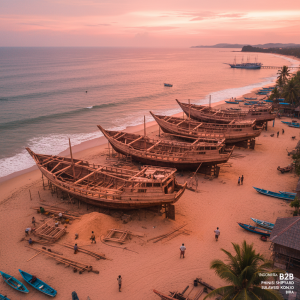
Haji Ambo, a man in his late 60s whose hands are a testament to over 45 years of shaping wood, speaks with quiet authority. “We do not build boats,” he explains, sipping coffee in the shade of a half-finished hull. “We give birth to them. The wood has a spirit. You must listen to it. The plan is not on paper; it is in the heart.” He gestures towards the towering 40-meter skeleton of a new yacht taking shape on the white sands of Bira beach, its frame constructed entirely of ironwood and teak.
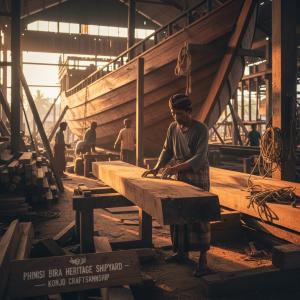
He describes the intuitive process passed from father to son. “A Western builder starts with drawings, with ribs. We start with the keel, the spine. We build the skin first, plank by plank—each one up to 7 cm thick—and then we fit the ribs inside.” This organic, hull-first methodology, which uses thousands of hand-carved wooden dowels instead of metal nails, is a hallmark of the Konjo technique, a testament to a deep understanding of naval dynamics that predates computer-aided design by centuries.
The Rituals Before the First Plank is Laid
The construction of a phinisi is steeped in ceremony, with at least five major rituals marking key stages of the build. Before the first timber is cut, the *Panrita Lopi* seeks blessings for a safe build. “We must ask permission,” Haji Ambo notes. “From the forest for the wood, and from the sea that will become its home.” This involves a *sanggar* ceremony, where offerings of sticky rice, sugar, and sometimes the sacrifice of a chicken are made to appease the spirits of the land and ocean.
The laying of the keel, known as the *lunas*, is a foundational Konjo ritual timed to an auspicious day, such as the 5th or 7th day of the lunar month, to ensure prosperity. This communal affair involves builders and owners placing coins or a piece of 24-karat gold at each end of the keel. These rituals are a profound expression of the Konjo worldview, signifying the interconnectedness of humanity, nature, and the spiritual realm.
From Bilang Lopi to Finished Yacht: The Process
The journey from concept to creation begins with the *bilang lopi*, the ‘reckoning of the boat’. This is the initial calculation of dimensions, where the *Panrita Lopi* uses sacred formulas to determine key ratios, such as the beam being roughly one-third of the vessel’s length. From this mental blueprint, the physical work begins on the shores of Bulukumba, using traditional tools like the adze (*binko*) and hand drill (*gurdi*) that have changed little over hundreds of years.
Laying the Keel and Stem
The process starts with sourcing the finest tropical hardwoods, primarily *kayu ulin* (ironwood) for the keel and *kayu bitti* (a type of teak) for the planking. The massive keel is laid upon the sand, and the stem and stern posts are joined using intricate wooden dowels, without a single metal nail or screw in this foundational structure.
Planking the Hull
Next, the master builders begin the painstaking process of shaping and fitting the hull planks. Each board is heated over a fire, bent by hand, and fastened to its neighbour. The hull rises organically from the keel, its form dictated by the builder’s eye and the inherent properties of the wood. Only when the hull shell is complete are the internal ribs meticulously cut and fitted into place, a reverse of the Western frame-first method.
Integration and Finishing
It is at this stage that the modern phinisi shipyard truly merges tradition with technology. Once the traditional hull and superstructure are complete, our teams of engineers, electricians, and interior craftsmen begin their work. State-of-the-art navigation systems, marine-grade wiring, powerful engines, and bespoke luxury interiors are seamlessly integrated, ensuring the vessel meets the highest international standards of safety, comfort, and performance.
Passing the Torch: The Future of Phinisi Shipbuilding
The survival of this unique craft depends on the next generation. “The young must learn with their hands, not just their eyes,” Haji Ambo reflects. “Knowledge is not in a book. It is in the feeling of the wood, the sound of the adze, the balance of the hull. It takes patience.” He is optimistic, noting that the global demand for authentic, custom-built phinisi yachts is creating new opportunities for apprentices.
Phinisi Shipyard is committed to this cultural preservation. By providing consistent, high-value projects, we create a stable environment where masters like Haji Ambo can afford to take on and train younger builders. This ensures that the skills are not only preserved but are also seen as a viable and respected profession. It is a symbiotic relationship: our clients receive a vessel of unparalleled heritage and quality, and the Konjo community secures the future of its most precious legacy.
Commission Your Legacy
To begin a conversation about creating your own custom-built phinisi, a vessel that embodies centuries of maritime artistry and modern luxury, please contact our project management team. We facilitate a direct and transparent process, from initial consultation with the master builders to the final launch. For detailed inquiries, please reach our B2B team via email at [email protected] or on WhatsApp at +62 811-3941-4563.
Frequently Asked Questions about the Phinisi Shipyard
What makes a phinisi yacht unique?
A phinisi is defined by its traditional Konjo shipbuilding method, a UNESCO Intangible Cultural Heritage. It is built hull-first without blueprints, using techniques passed down through generations in South Sulawesi. This heritage, combined with its iconic gaff-ketch rig of seven sails and modern luxury amenities, creates a vessel that is truly unique in the world. Its soul comes from the hands and intuition of its master builders, the *Panrita Lopi*.
Who are the Konjo people?
The Konjo are an ethnic group from the Bulukumba Regency in South Sulawesi, Indonesia, particularly from the villages of Bira, Ara, and Lemo-Lemo. They are globally renowned as master mariners and the builders of the phinisi ships. Their shipbuilding skills are an integral part of their cultural identity, a legacy that has been honed over centuries and is passed down from father to son, making them the authentic custodians of this craft.
What type of wood is used to build a phinisi?
Traditional phinisi construction relies on tropical hardwoods chosen for their durability and resistance to the marine environment. The keel is typically made from incredibly dense and resilient *kayu ulin* (ironwood). For the hull and frames, builders often use *kayu bitti* (vitex cofassus) or teak. The selection of the right timber is a critical skill of the *Panrita Lopi*, who assesses each piece for its grain, strength, and spiritual suitability.
How long does it take to build a custom phinisi?
The construction timeline for a custom luxury phinisi at our shipyard typically ranges from 18 to 24 months. The duration depends on the vessel’s size, the complexity of the interior design, and specific technical requirements. The initial phase of traditional hull construction by the Konjo builders can take up to a year, followed by the meticulous process of technical installation, interior outfitting, and finishing to international yachting standards.
Is the traditional building process safe?
While the hull construction is traditional, our phinisi shipyard integrates modern engineering oversight and international maritime safety standards (such as RINA or BKI classification) from day one. We combine the time-honoured strength of Konjo construction with contemporary best practices in naval architecture, stability calculations, and the installation of modern safety, navigation, and engine systems. The result is a vessel that is both culturally authentic and exceptionally seaworthy.
What does ‘Panrita Lopi’ mean?
The term *Panrita Lopi* is from the Konjo language and translates to ‘master shipbuilder’. A *panrita* is a man of wisdom or an expert, and *lopi* means boat. However, the title signifies much more than technical skill. A *Panrita Lopi* is a respected community elder who holds the ancestral knowledge of boat design, construction techniques, and the spiritual rituals associated with bringing a new vessel to life.
Can I visit the shipyard where my phinisi is being built?
Yes, we encourage prospective clients who are in the advanced stages of commissioning a vessel to visit the partner yard in South Sulawesi where your vessel is being built. A site visit offers an unparalleled opportunity to witness the remarkable craftsmanship of the Konjo builders firsthand and to discuss the specifics of your project with our management team and the *Panrita Lopi*. These visits are arranged by appointment to ensure our team can provide their full attention.
How is the interior of the phinisi designed?
The interior design is a collaborative process between the client, our in-house design team, and specialist naval architects. While the exterior hull is traditional, the interior is a blank canvas for bespoke luxury. We work with you to create custom layouts, select premium materials, and integrate all the modern amenities you would expect on a world-class yacht, from gourmet galleys and en-suite cabins to advanced entertainment and dive-compressor systems.
What is the difference between a phinisi and a gulet?
While both are traditional wooden motor-sailers, their origins and construction are entirely different. A gulet is a Turkish vessel, traditionally built frame-first in the Mediterranean style. A phinisi is Indonesian, built hull-first using the unique Konjo method in South Sulawesi. The phinisi also has a more distinct aesthetic, with its high, elegant stern and characteristic seven-sail gaff-ketch rig, which holds deep philosophical meaning for the Konjo and Bugis people.
Why is the building process done on the beach?
Building directly on the beach is a fundamental part of the Konjo tradition. This practice allows for the construction of massive vessels without the need for complex modern shipyard infrastructure like slipways or travel lifts. The launch is a spectacular community event, where the finished boat is moved into the sea over wooden rollers during high tide. This direct connection to the sea is integral to the entire building philosophy.
Does Phinisi Shipyard build for private owners?
Absolutely. While we are a leading B2B builder for charter operators, a significant portion of our work involves commissioning bespoke phinisi yachts for private owners and family offices. We offer a comprehensive, turnkey solution, managing the entire process from the initial design concept and traditional build to the final luxury outfitting, classification, and delivery. We pride ourselves on discretion and a highly personalised service for our private clients.