Updated: August 2026
Walking a phinisi yard is easier when you know what you are looking at. This glossary covers the tools and terms that come up most often, in plain language, so that a site visit becomes a conversation rather than a guided tour.
- Traditional hand tools still do the shaping work that defines a hull’s fairness.
- Measuring and marking tools — battens, spiling, levels — are where accuracy actually lives.
- Knowing the vocabulary changes the questions you can ask, and therefore the answers you get.
Shaping tools
Adze. A long-handled tool with the blade set across the handle, swung to remove wood in controlled shavings. It remains the primary tool for shaping large timbers, and watching an experienced hand use one is the fastest way to understand why craft matters in this construction method.
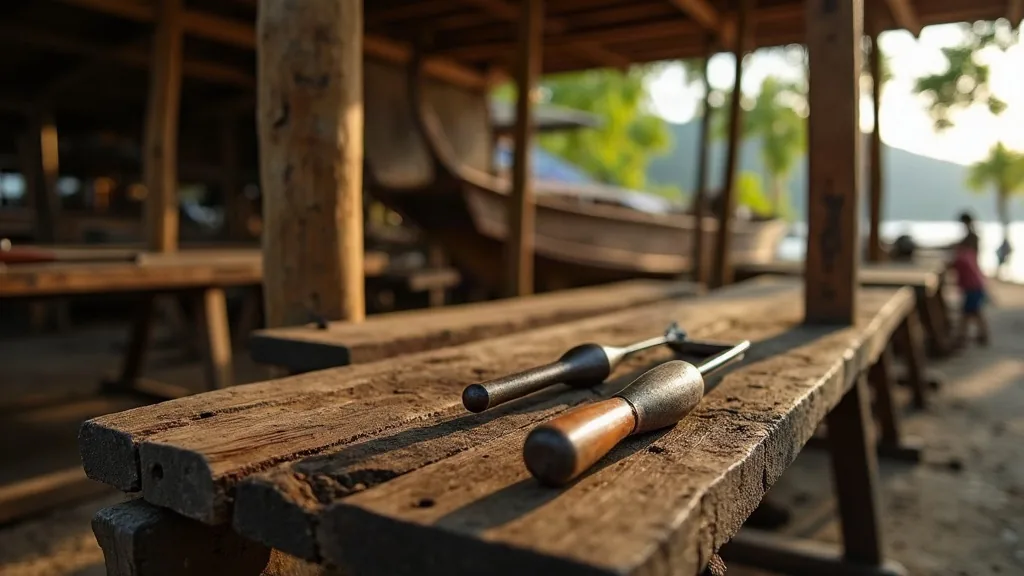
Chisel and slick. Chisels for joint work, and larger slicks pushed rather than struck for paring long surfaces flat. Their condition tells you about the yard: sharp, stored tools indicate care; blunt tools in a pile indicate a different attitude.
Plane. Used for fairing surfaces and fitting plank edges. Hand planing remains common on curved work where a machine cannot follow the shape.
Auger and brace. For boring the holes that receive dowels and fastenings. Consistency of hole alignment and spacing is a direct quality indicator on a planked hull.
Measuring and marking
Batten. A long flexible strip laid along the hull to check fairness. If a batten laid on the planking touches evenly along its length, the hull is fair; where it lifts or rocks, it is not. This is the simplest and most revealing quality check available to a visitor.
Spiling. The process of transferring the shape of a hull’s edge onto a plank so that the plank can be cut to fit precisely. Spiled planks sit naturally in place; planks cut to a guess must be forced, and forced planks carry stress.
Bevel gauge. An adjustable tool for capturing and transferring angles, essential where every frame meets the planking at a slightly different angle.
Moisture meter. A modern instrument that measures water content in timber. Its presence in a traditional yard is a strong positive signal, because it means seasoning is being verified rather than assumed.
Fastening and sealing
Dowel (pasak). A wooden peg driven into bored holes to fasten planks edge to edge and to secure planking to frames. Central to traditional construction and immune to the corrosion that affects metal fastenings in tropical conditions.
Caulking iron and mallet. Used to drive sealing material into seams between planks. The sound of caulking is distinctive, and the evenness of the work is visible along the hull.
Paying. Sealing over driven caulking with a compound to protect it and complete the seam.
Structural vocabulary
Keel. The primary longitudinal backbone. Stem and sternpost: the vertical or raked members at bow and stern. Frames: the transverse structure. Floors: members tying frames across the keel. Sheer: the curve of the deck edge seen from the side, and the line that most determines whether a vessel looks right. Scarf joint: an angled joint used to join timbers end to end, common in keels and long members, and a fair test of a yard’s joinery standard.
Using the vocabulary on a visit
You do not need to use these terms to sound expert; you need them to ask precise questions. Asking whether planks are being spiled or cut to a pattern, whether moisture content is measured before use, or how scarf joints in the keel were laid out will produce specific answers from the people doing the work.
That specificity is the point. Vague questions get reassurance. Precise questions get information, and the quality of the information you gather before signing is what determines how much you will need to intervene afterwards.
Terms you will hear in the contract, not on the slipway
A second vocabulary appears in the paperwork. Scantlings are the dimensions of structural members, specified by the designer and verifiable with a tape. Displacement is the weight of water the vessel displaces, and therefore its weight. Gross tonnage is a calculated volume figure that drives regulatory thresholds rather than a measure of weight. Freeboard is the height of the hull above the waterline. Trim is the fore-and-aft attitude of the vessel afloat.
These matter because they turn up in specifications and certificates, and because confusing tonnage with weight or displacement with capacity leads owners to agree to things they did not intend. If a term appears in your contract and you cannot define it precisely, ask before signing rather than after. Designers and surveyors expect the question and answer it in a sentence.
Frequently asked questions
Do traditional yards use power tools?
Yes, extensively, for dimensioning and repetitive work. Hand tools persist where they outperform machines: shaping curved timbers, fitting planks and fairing surfaces that no machine can follow accurately.
What is the simplest quality check I can do myself?
Sight along the hull from a low angle at bow and stern, and look at the sheer line. Unfairness, flat spots and inconsistent seam widths are visible to any careful eye. A batten laid along the planking makes the same check objective.
Should a traditional yard have a moisture meter?
It is a strong positive indicator. Seasoning is the specification item most often assumed rather than verified, and a yard that measures moisture content before use is managing the risk that causes most later timber movement.
Related reading
Working with our build desk
If you would like this glossary alongside a site checklist before your yard visit, the build desk can send both. You can reach the build desk on WhatsApp at +62 811-3941-4563 or by email at [email protected]. Construction and supervision contracts are issued by PT Komodo Galangan Nusantara; Phinisi Shipyard is a specialist maritime brand under Juara Holding Group.