Updated: August 2026
Planking is where a hull stops being a drawing. The method a yard uses — and the discipline with which it applies that method — determines watertightness, structural stiffness, and how the vessel behaves in its first seasons afloat. Indonesian yards are not uniform in this, and the differences are worth understanding before you choose one.
- Edge-doweled shell-first planking is the traditional South Sulawesi approach and is unusual worldwide.
- Seam treatment and plank fit matter more to watertightness than the fastening type does.
- Modern hybrids add sheathing or epoxy systems, which change both maintenance and repairability.
The traditional approach: edge-fastened shell
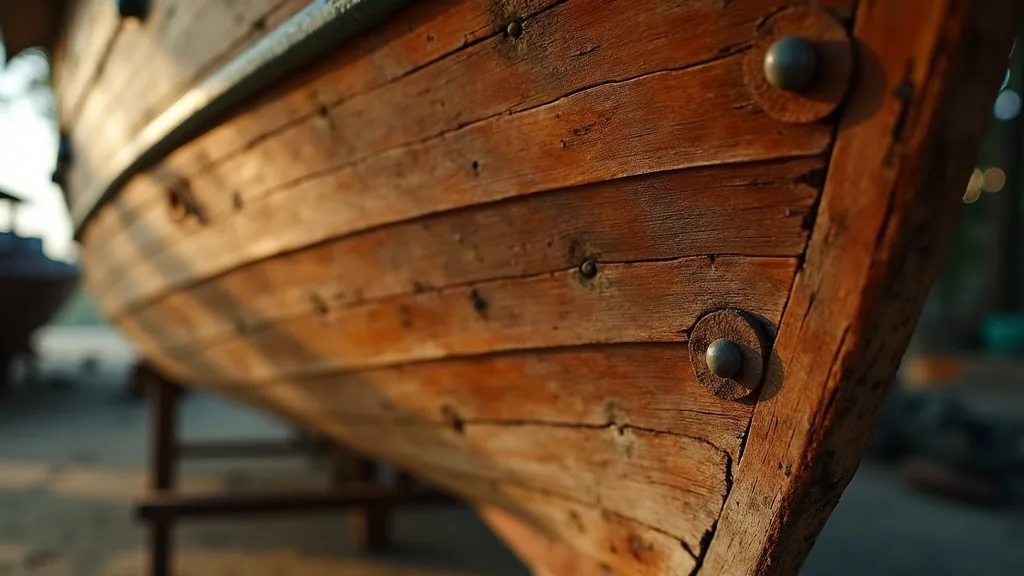
In classic South Sulawesi practice, planks are fastened edge to edge with wooden dowels driven into holes bored along the plank edges. Each new plank is fitted to the one below, and the shell rises as a self-supporting structure before internal framing is added. The method demands exceptional accuracy in plank shaping, because there is no frame to force a plank into position; the plank must want to sit where it is placed.
The strength of this approach is a hull that behaves as a continuous shell rather than as a skin over ribs. Its weakness is that it is unforgiving of poor workmanship. A plank forced into place carries locked-in stress, and that stress finds release later, usually as an opened seam.
Carvel, and where the traditions blend
Carvel planking — smooth-seamed planks fastened to frames, with seams caulked — is the dominant tradition across much of the world and appears in Indonesian yards too, particularly where builds follow drawn frames. Many contemporary Indonesian builds are effectively hybrids: shell-first construction with dowels, then internal frames, then caulked or sealed seams in a manner recognisable from carvel practice.
Neither is inherently superior. What matters is that the yard is doing consistently what it says it is doing. A hull that mixes methods opportunistically, because a crew changed halfway up, is the outcome to avoid, and it is visible in the seam lines if you look along the hull from a low angle.
Seams: the detail that decides watertightness
Seam preparation is where hulls are won or lost. The seam must be shaped to accept its caulking or sealant, consistently along its length, and the material must be appropriate to the movement expected. Traditional practice uses natural fibre driven into the seam and payed over; modern practice may use flexible marine sealants. Both work. What does not work is inconsistency: seams that vary in width, that are filled with different materials along a run, or that are closed over surfaces that were not clean and dry.
Owners can check this without technical training. Sight along the hull. Seams should read as parallel and even. Where a run visibly widens or narrows, ask why. The answer is sometimes legitimate and sometimes the first admission of a plank that was fought into place.
Sheathing and epoxy: what you gain and what you accept
Some builds apply a sheathing layer — commonly glass fibre with an epoxy system — over the timber shell. The attraction is obvious: reduced water absorption, a fair surface for finishing, and less seam maintenance. The trade-off is less obvious. Sheathing changes how the hull dries, how repairs are made, and how easily a defect beneath the sheathing can be detected before it becomes serious.
The critical requirement is that the timber be at the correct moisture content when sheathed. Sealing wet timber beneath an impermeable layer traps moisture against structure and can create exactly the decay problem the sheathing was meant to prevent. If a build is to be sheathed, moisture measurement before application should be a contractual checkpoint, not an assumption.
What to inspect while planking is in progress
Visit during planking if you can, because the evidence disappears as the hull closes. Look for consistency of plank thickness, evenness of seam width, regularity of dowel spacing, and the absence of visible strain around sharp curves. Ask how planks are being fitted — spiled from the hull, or cut to a pattern — and whether any have been steam-bent or laminated to reach their shape.
Ask, too, what happens to a plank that does not fit well. The honest answer in a good yard is that it is remade. In a yard under schedule pressure, it is persuaded into place. That single question, asked casually while standing at the hull, often produces the most useful answer of the entire visit.
Frequently asked questions
Is edge-doweled planking watertight on its own?
The shell is structurally continuous, but seams are still treated to achieve watertightness, and a newly launched timber hull normally takes up as the planking swells. What prevents long-term leaks is accurate plank fit and consistent seam work rather than the dowels themselves.
Should I ask for a sheathed hull?
It depends on the intended use and maintenance regime. Sheathing reduces routine seam maintenance and water absorption but complicates repair and requires the timber to be at the correct moisture content before application. For a commercially operated vessel with a tight turnaround schedule, the maintenance argument is often persuasive.
How thick should the planking be?
That is set by the designer against vessel size, structure and intended service, and it should be stated in the specification with the species named. Any variation in delivered thickness should be measured rather than eyeballed, because it is one of the few structural parameters an owner can verify directly.
Related reading
Working with our build desk
If you want plank and seam quality assessed independently during your build, that inspection is best scheduled mid-planking. You can reach the build desk on WhatsApp at +62 811-3941-4563 or by email at [email protected]. Construction and supervision contracts are issued by PT Komodo Galangan Nusantara; Phinisi Shipyard is a specialist maritime brand under Juara Holding Group.