Updated: August 2026
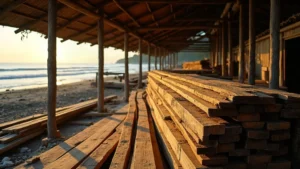
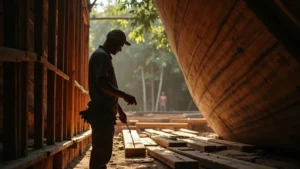
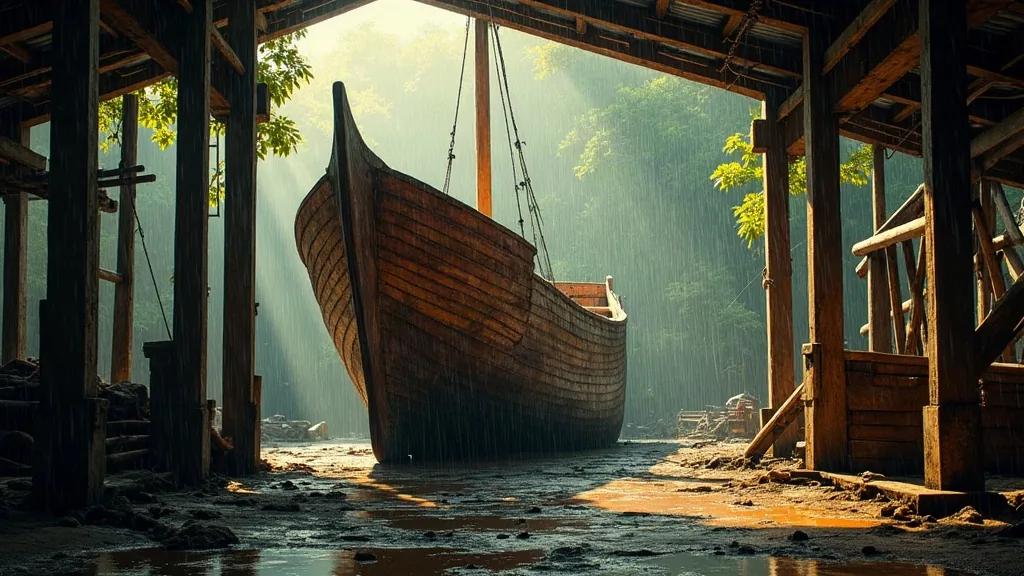
Most traditional phinisi are built in the open, and vessels built that way have crossed oceans for centuries. But covered building changes three things measurably: moisture control during construction, schedule reliability through the wet season, and the quality achievable in coatings and finishing. Whether that matters depends on what you are building.
- Open-air building is the tradition and works, provided the programme respects the weather.
- Cover matters most during finishing, coating and joinery, not during heavy structural work.
- If a yard builds in the open, sequence the programme so the hull is closed in before the wet months.
What rain actually does to a build
The obvious effect is lost working days. The less obvious and more important effect is moisture in materials. Timber that gets repeatedly wet and dries again moves; timber left standing in water absorbs it; and coatings applied to damp surfaces fail early. Where a hull is open to the sky for months, water collects in the bilge and in every horizontal joint, and it must be actively managed rather than allowed to find its own way out.
Well-run open yards handle this. They tarpaulin selectively, they keep drainage clear, they schedule coating work in dry windows, and they store timber under cover even when the hull is not. Poorly run open yards do none of that, and the difference shows up two seasons later as coating failure and localised decay.
Where cover earns its cost
Covered building is expensive to provide, which is why it is not universal. Its value is concentrated in specific phases: interior joinery, insulation, electrical installation, paint and varnish work, and any epoxy or sheathing application where humidity and surface moisture directly affect the result. A yard that can move a hull under cover for finishing, or build a temporary shelter over it, gets most of the benefit without the cost of a permanent shed.
For a commercially operated vessel with a fixed launch season, the schedule argument is often decisive. Covered work continues through weather that stops open work entirely, and the ability to keep the critical path moving in the wet months can be worth more than the cover costs.
Sequencing an open-air build
If your yard builds in the open — which is likely for traditional construction — the answer is sequence rather than complaint. Aim to have the hull structurally complete and closed in before the heaviest rains. Schedule coating and finishing for drier periods. Push interior work into whatever covered space exists. Accept explicitly in the programme that certain months will be slower, rather than discovering it and calling it a delay.
Owners who negotiate a programme that pretends the rainy season does not exist end up in the worst position: a schedule that was never achievable, a yard that is technically in default, and a relationship that sours over something both parties could see coming from the beginning.
Temporary shelter as the middle path
Many yards erect temporary structures over a hull for the finishing phase: a frame with sheeting, open at the sides for ventilation. It is unglamorous and it works. It keeps direct rain off the deck and out of the interior, it shades surfaces so coatings do not flash off in the heat, and it lets work continue on days that would otherwise be lost.
This is worth discussing at contract stage, because it costs money and someone must pay for it. Owners who raise it early usually find the yard willing; owners who raise it during a wet week usually find it becomes a variation order.
What to look for on a site visit
Visit during or just after rain if you can, because that is when a yard’s weather habits are visible. Is water standing under the hull, or does the ground drain? Is timber stock dry and covered? Are tarpaulins doing a job or simply lying over things and trapping moisture? Is there any shelter over the joinery workshop? Are electrical leads and tools kept out of the wet?
These are ordinary questions with informative answers. A yard that has thought about weather has thought about the vessel’s twenty-year life. One that has not is optimising for today, which is a fair way to run a business and a poor way to build your hull.
Frequently asked questions
Is a hull built in the open lower quality?
Not inherently. Traditional vessels have been built in the open for centuries and have proven durable. What matters is whether the yard actively manages moisture, drainage, timber storage and coating conditions, and whether the programme is sequenced around the wet season.
Should I pay for a temporary shelter over my build?
Often yes, particularly for the finishing phase and for a build that must hit a fixed season. It typically costs a small fraction of the build and protects both schedule and finish quality. Agree it at contract stage so it is priced rather than negotiated under pressure.
When is the worst time to start a build?
Starting so that the hull is still open when the heaviest rains arrive is the least efficient sequence, because the most weather-sensitive early work coincides with the least workable conditions. A start timed to get the shell up and the vessel closed in before that period usually saves weeks.
Related reading
Working with our build desk
If your start date is flexible by a month or two, we can help you time it against the wet season properly. You can reach the build desk on WhatsApp at +62 811-3941-4563 or by email at [email protected]. Construction and supervision contracts are issued by PT Komodo Galangan Nusantara; Phinisi Shipyard is a specialist maritime brand under Juara Holding Group.