Updated: August 2026
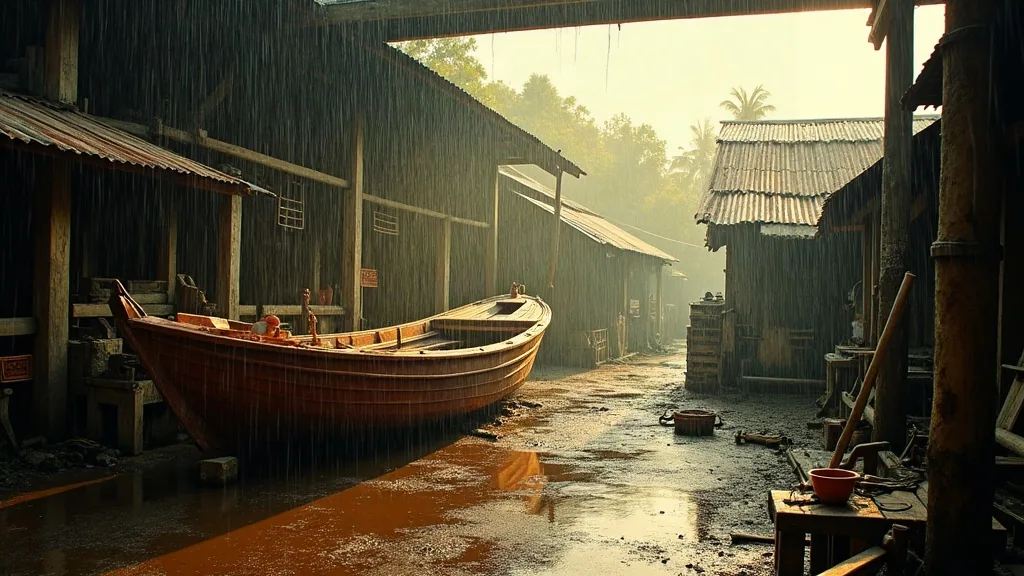
Weather is the most predictable variable in an Indonesian build programme and the most frequently ignored. The wet season does not stop a build, but it slows specific phases badly, and a programme that pretends otherwise turns a known constraint into an argument about delay.
- Exterior structural work and coatings are the phases most exposed to rain.
- A hull closed in before the wet months keeps interior work moving regardless of weather.
- Weather allowance belongs in the programme explicitly, not as an unspoken hope.
Which phases the rain actually hits
Not all work is equally weather-sensitive. Heavy structural work in the open — keel, frames, planking, decking — loses days to rain but is otherwise robust; timber gets wet and dries. The phases that suffer materially are those where moisture affects the result: coating and varnishing, epoxy and sheathing application, insulation, and any interior work in a hull that is still open to the sky.
Electrical installation deserves particular mention. Running cable and installing equipment in a hull that is taking rain is bad practice, and yards under schedule pressure sometimes do it anyway. Water in places that will shortly be closed behind joinery is a fault that surfaces in the vessel’s second year and is expensive to trace.
The closing-in target
The single most valuable scheduling objective in a seasonal climate is to get the hull structurally complete and closed in — deck on, superstructure weathertight — before the heaviest rains. Once closed, the interior becomes a workspace and progress continues through weather that would stop an open build entirely.
This objective should drive the start date. A build that begins so that planking coincides with the wettest months will lose weeks and will arrive at the interior phase later than one that started at a better point in the year. Where the start cannot be moved, the answer is temporary shelter, agreed and priced in advance.
Weather allowance in the programme
A programme with no weather allowance is a fiction that both parties will later resent. A better approach names the expected wet period, states the assumed reduction in productive days for exterior work, and builds that into the dates. Then, when it rains, nobody is in default and nobody is surprised.
The same document should say what happens if weather is materially worse than the assumption. A simple clause giving relief for exceptional conditions, with a defined threshold, prevents the argument that otherwise arrives at exactly the moment when goodwill is most needed.
Second-order effects owners miss
Rain affects more than the yard. It affects road transport of timber and equipment to remote sites, it affects sea delivery of heavy items, and it affects the availability of subcontractors who are also being delayed on other projects. A single wet month can therefore cost more than its own working days by pushing a supplier and a subcontractor out of sequence at once.
The mitigation is ordering and scheduling early enough that a delivery has slack before it is needed. Items that arrive a month before installation cost storage; items that arrive a month late cost the critical path.
Planning a launch around the season
Launch timing deserves its own attention. Tidal launches depend on spring tides, and both airbag and rail launches depend on firm ground and calm conditions. A launch planned for the middle of the wet season may be postponed repeatedly for reasons entirely outside the yard’s control, and each postponement carries cost if crew and surveyors have been mobilised.
Working backwards from a target launch window in the drier part of the year, and then setting the start date accordingly, is the most reliable way to build a programme that survives contact with the calendar.
What a weather-aware programme looks like on paper
A programme that respects the season states four things explicitly. It names the months assumed to be materially affected by rain. It states the productivity assumption applied to exterior work during those months. It identifies the closing-in milestone and where it falls relative to the wet period. And it sets a launch window in a part of the year when tides, ground conditions and weather realistically permit a controlled launch.
Owners can ask for this in a single page, and the request usually improves the conversation immediately. A yard that can produce it has thought about delivery; a yard that resists it is planning to explain the weather later instead of now. It also gives both sides a shared reference when conditions are genuinely worse than assumed, because the argument then concerns a measurable deviation from a stated baseline rather than competing memories of how bad the season was.
Frequently asked questions
How many working days does the wet season typically cost?
It varies by site and year, which is exactly why the programme should state an assumption rather than ignore the question. What matters is that both parties agree in advance what a normal wet period looks like and what happens if it is materially worse.
Can work continue in the rain at all?
Some can. Machining under cover, joinery in a workshop and interior work in a closed hull all continue. What stops is exposed structural work, coating, and anything where moisture affects the result.
Should I delay my start to a better season?
Often yes, if the alternative is planking through the wettest months. A start delayed by a few weeks to achieve closing-in before the rains frequently delivers earlier than one that begins immediately at the wrong point in the year.
Related reading
Working with our build desk
If you are choosing a start date, we can sequence it backwards from your target launch window. You can reach the build desk on WhatsApp at +62 811-3941-4563 or by email at [email protected]. Construction and supervision contracts are issued by PT Komodo Galangan Nusantara; Phinisi Shipyard is a specialist maritime brand under Juara Holding Group.